Learn & internalize whole-body safety
Learn a residual Q-CBF from black-box transitions, then distill its safety guidance into a task policy.
Safe whole-body control requires coordinating collision avoidance and balance under high-dimensional, nonlinear dynamics, which makes safety certificates hard to design and reuse across behaviors. We present LIMBO, a framework for synthesizing a state–action control barrier function and distilling its safety structure into a task policy. LIMBO learns the safety certificate from black-box transitions and a state-based failure specification over residual actions around a frozen base controller, making Q-CBF synthesis tractable in the full control dimension while placing the certificate in the task policy's control space. During synthesis, the learned safety value drives risk-guided sampling near the estimated boundary of recoverability; during task learning, it serves as a teacher that provides action-level safety feedback, yielding a robust task policy and removing the need for an online safety filter at deployment. We demonstrate LIMBO on a 29-degree-of-freedom humanoid performing dodgeball avoidance and locomotion beneath low obstacles. Beyond scaling learned Q-CBFs to whole-body control, we show that risk-guided boundary sampling provides a theoretically grounded way to explore the edge of recoverability. Under the same safety specification, ceteris paribus, varying the sampling concentration produces strategies ranging from crouching to a novel backward-leaning limbo maneuver. In both settings, the learned policies transfer to hardware without online safety filtering, showing that learned safety synthesis scales to agile whole-body control.
Learn a residual Q-CBF from black-box transitions, then distill its safety guidance into a task policy.
Changing how tightly sampling concentrates on the safety boundary yields crouching or a backward-leaning limbo, under the same safety specification.
Policies scale to a 29-DoF humanoid and transfer to hardware without an online safety filter.
Task Balls are thrown at the robot. It has to avoid being hit while keeping its balance and staying near where it started.
The policy uses only proprioception and ball positions. We compare against CBF-RL, which trains with a hand-designed barrier.
Task The robot walks forward and has to pass under a horizontal bar without touching it or falling.
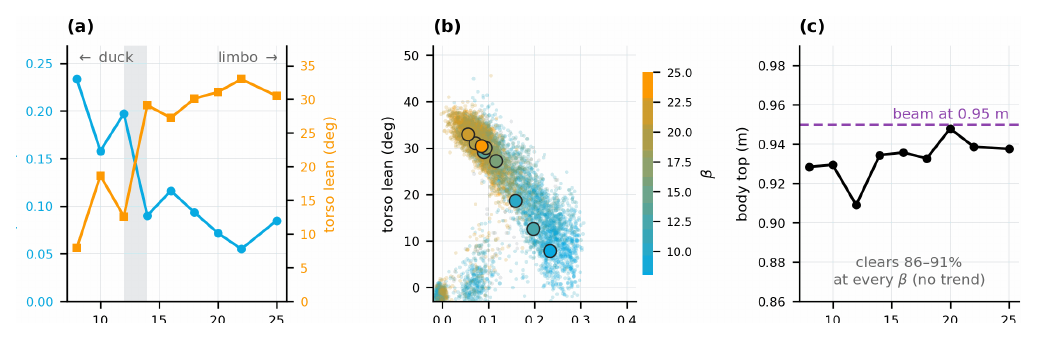
The safety specification never says how to clear the bar. By changing only the replay concentration β, synthesis finds either a duck (drop the pelvis) or a backward-leaning limbo (tilt the torso back).
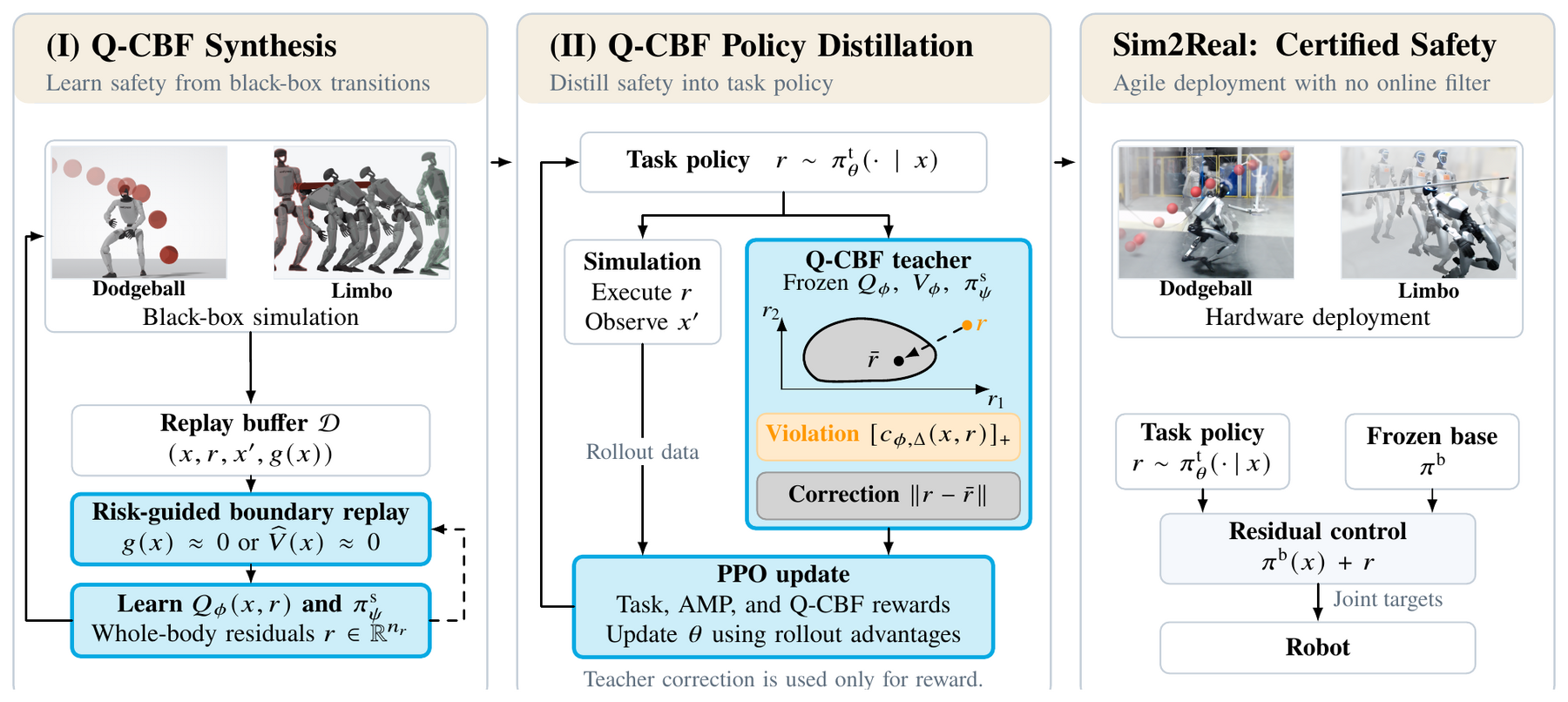
Stage I: Q-CBF synthesis. Around a frozen base controller, LIMBO learns a state–action safety value Qφ(x, r) over whole-body residual actions, using only black-box simulator transitions and a state-based safety margin g(x). Risk-guided boundary replay concentrates learning near the edge of recoverability.
Stage II: Q-CBF policy distillation. The frozen Q-CBF acts as a safety teacher. It scores each proposed action by its constraint violation and its distance to the nearest safe action, and those scores shape the PPO reward. The teacher only shapes the reward and never overrides the policy, so the deployed policy runs without any online filter.
@inproceedings{limbo2027,
  title     = {LIMBO: Learning and Internalizing Model-Free Barrier Objectives
               for Agile and Safe Whole-Body Control},
  author    = {TODO},
  booktitle = {IEEE International Conference on Robotics and Automation (ICRA)},
  year      = {2027}
}